



Deep tech innovation
The physics behind
EVA Cooling®
Liquid cooling heats a liquid. Two-phase cooling makes it evaporate and condense, the most efficient way to move heat away from electronics. This latent heat of vaporisation is the same physics proven in aerospace and nuclear engineering, and it absorbs 5–10× more heat than single-phase liquid cooling, engineered for the growing thermal demands of AI data centres.
How it works
Three steps. One closed loop.
1
Evaporation
Our patented dielectric fluid* absorbs heat at the cold plate and evaporates. The higher the thermal power of the chip, the higher the quantity of vapour. The surface stays isothermal, with no hot spots.
2
Vapour Transport
Vapour carries the heat away. Latent heat of vaporisation means low flow rates and a fraction of the pump power single-phase liquid cooling needs.
3
Condensation
Vapour releases heat at the condenser and returns to liquid. The loop is closed and repeats.
*EVA Cooling uses a patented, waterless dielectric fluid with a boiling point of 10–40°C, which provides electrical insulation and serves as the coolant.
Two-phase loop · in motion
Fig. 1 — Two-phase mechanically pumped cooling loop
The hardware
See the phase change happen.
The cold plate sits directly on the processor. Coolant enters as liquid, boils on contact with the heated surface, and leaves as vapour, visible as it happens.
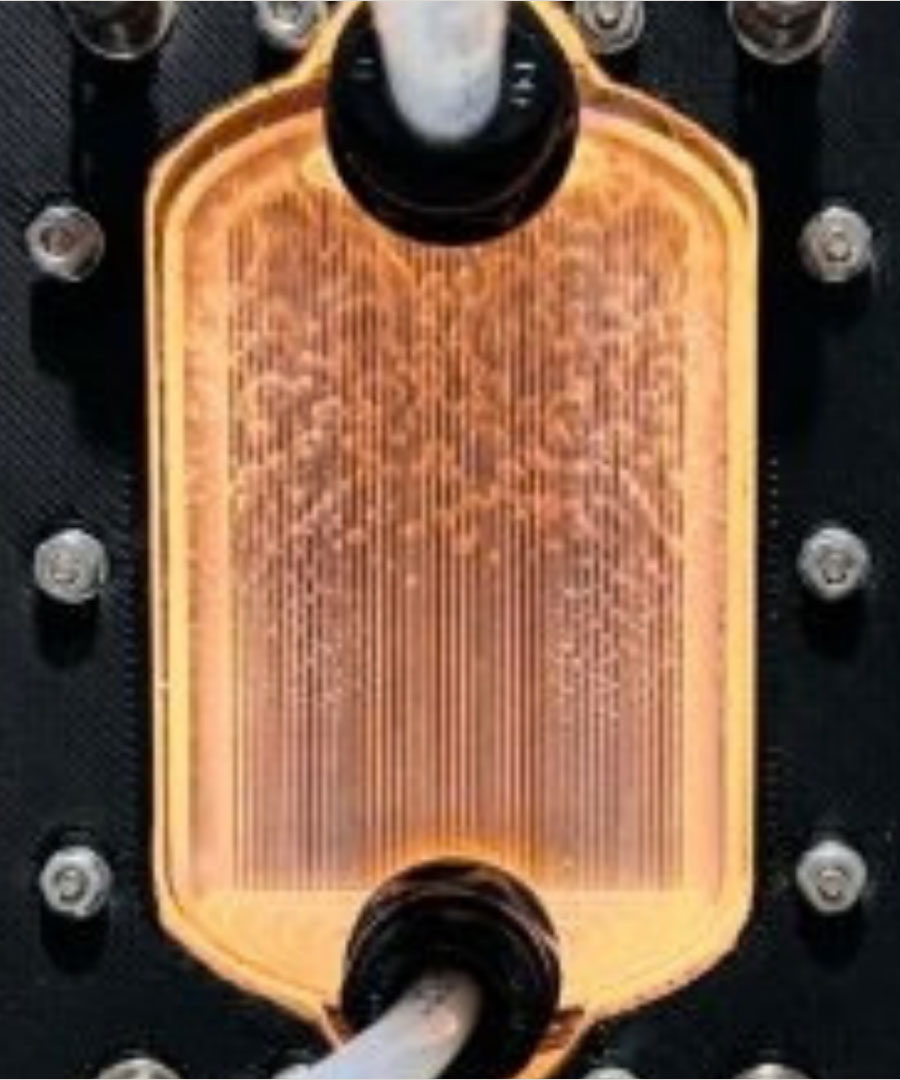
Boiling at the cold plate. The coolant changes state on the chip surface, holding it isothermal.
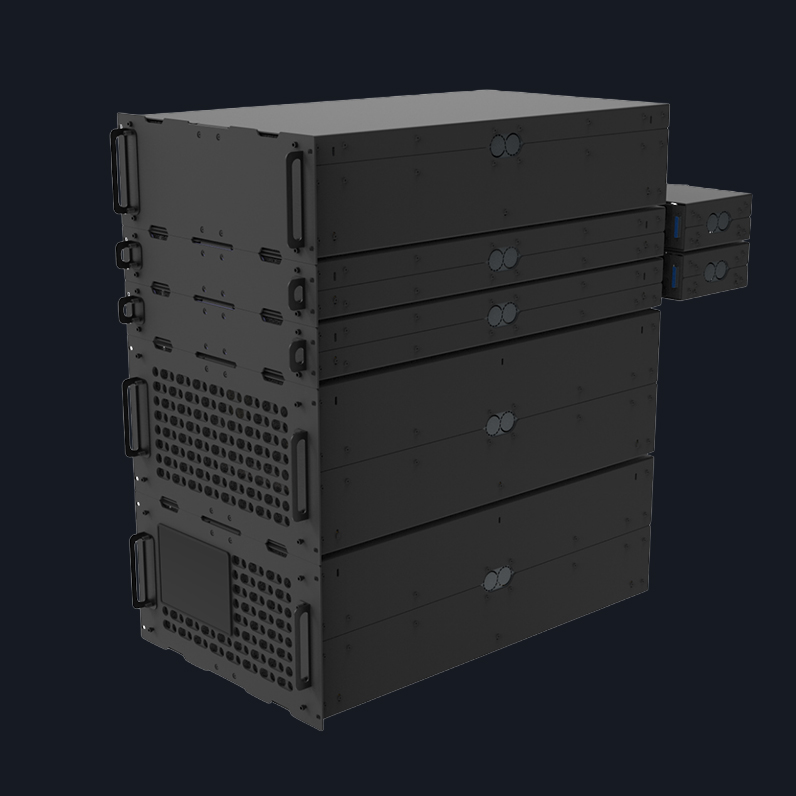
EVA Cooling in a standard 42U rack. No evaporative tower, no chillers, no raised-floor rebuild.
Competing Cooling Technologies
How EVA Cooling® compares, field by field.
| Air | Immersion | Single-Phase D2C | Two-Phase D2C (EVA) | |
|---|---|---|---|---|
| Fluid Volume (42U) | N/A — no fluid | 1,483 Litres | 11 Litres | 9 Litres |
| Fluid Replenishment | N/A | Yes — Evaporation | Yes — Water Maintenance | No — Closed Loop |
| Short-circuit risk if fluid leaks | No | No | Yes — Conductive | No |
| 42U–52U Cabinet Compatible | Yes | No | Yes | Yes |
| Infrastructure Required | Large A/C system, +30% overhead | High raised-floor loading | Facility-side chilled water | Standard rack, no evaporative tower |
Light in infrastructure
A 9-litre closed loop means low fluid weight, small-diameter pipes, small pump motors and low raised-floor loading, with high server compatibility. Immersion needs the opposite.
Source: Uptime Institute, adapted
Engineered to Perform
Thermal power density: 100 W/cm²
Minimal maintenance: no cleaning or fluid replacement required
Stable chip temperature under bursty AI loads, with Granular Active Control
Standard rack, no facility rebuild. One platform for storage, HPC and AI
Dielectric and non-conductive: no short-circuit risk
Scalable across configurations: 1,000W+ per processor and beyond
Engineered for Sustainability
On legacy air-cooled sites, around 40% of data-centre electricity goes into cooling, and water use and regulatory scrutiny are rising. EVA Cooling wasn’t designed with sustainability as an add-on feature. The same physics that makes it perform also makes it efficient. Zero water consumption, less energy, by design.
Up to 50%
Less energy vs air
<2
Fluid GWP
WUE 0
No water consumed for cooling