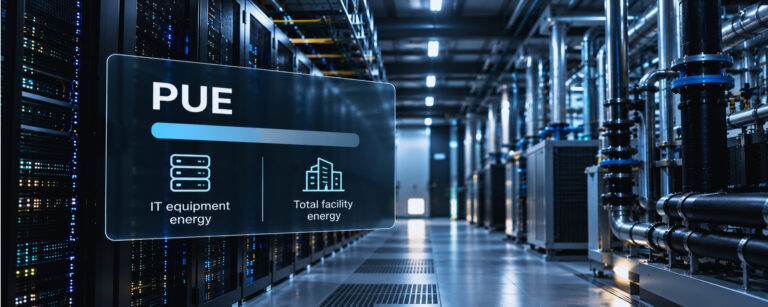


AI infrastructure cooling affects water resources in two ways: directly, through the water used to cool servers, and indirectly, through the water footprint of the electricity that powers them. As AI data centres expand, this relationship is becoming increasingly important.
Artificial intelligence is increasing the physical demands placed on data centre infrastructure. More computing power means more electricity, higher thermal densities and more heat to remove. But energy is not the only resource entering the equation. Water is increasingly part of it too. A report published in June 2026 by the United Nations University Institute for Water, Environment and Health estimates that global data centre electricity consumption could rise from 448 TWh in 2025 to 945 TWh by 2030. The associated water footprint is projected to reach 9.3 trillion litres, equivalent to the basic annual domestic water needs of 1.3 billion people in sub-Saharan Africa. Importantly, this figure does not represent water used exclusively for cooling: it includes the water footprint associated with cooling and electricity generation. The distinction matters, but so does the underlying trend. As AI infrastructure scales, so does the pressure it can place on water resources.
This makes the sustainability of AI infrastructure cooling a broader question than thermal performance or energy efficiency alone. Cooling systems must manage increasing heat loads, but they operate within physical environments where electricity, water and other resources cannot always be treated as unlimited.
9.3 trillion liters
The projected water footprint associated with global data centres by 2030.
When does water availability become an infrastructure issue?
There is no single answer to how much water is used to cool AI data centres. Consumption depends on the cooling architecture, local climate, facility design, heat-rejection method and the water footprint of the electricity supplying the site. What is becoming clearer, however, is that water availability needs to be considered alongside power availability and thermal capacity when planning infrastructure expected to operate for many years.
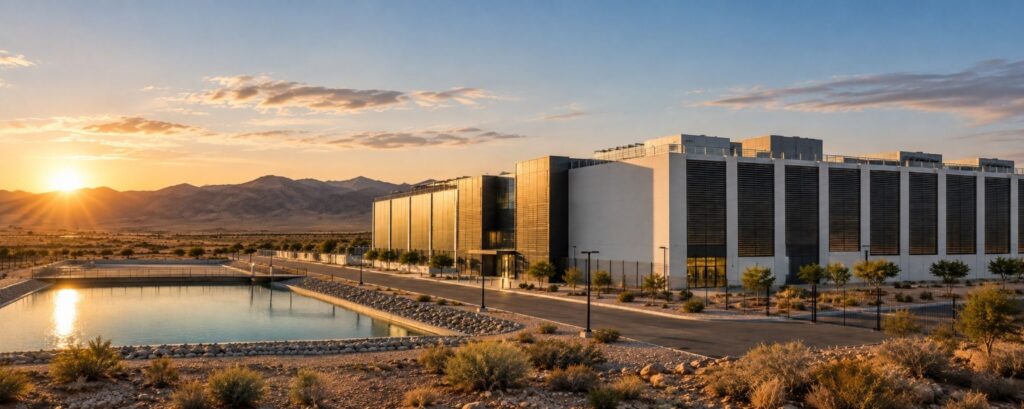
Research published by First Street in June 2026 analysed 97 data centre markets worldwide and found that 54% of global data centre capacity is located in markets exposed to chronic climate stress, including extreme heat and drought. According to the study, those conditions can increase cooling costs, reduce efficiency and put operating margins under pressure. The analysis shows how location is increasingly relevant to the long-term reliability and economics of data centre infrastructure.
Sunbird DCIM also highlighted the pressure placed on European data centre infrastructure during periods of extreme heat. Although its article was prompted by a heatwave, the more useful conclusion is structural rather than seasonal: cooling systems designed around historical temperature ranges may no longer reflect the conditions in which facilities actually have to operate. This does not mean that every facility in these areas will experience water shortages, nor that every cooling system using water should be considered unsustainable. It means that water can become an infrastructure constraint, and therefore part of the engineering decision.
A cooling architecture selected today may need to support several generations of increasingly dense AI hardware. Its sustainability should therefore be assessed not only against today’s thermal load, but also against the resources it will require as computing density increases.
Cooling efficiency is also about resource dependency
This is why energy efficiency and water efficiency cannot be considered in isolation. Different cooling architectures place different demands on electricity, water, pumping infrastructure, space and heat-rejection systems. Improving one parameter does not automatically improve all the others. The UNU-INWEH report makes the same point at a broader environmental level. Carbon, water and land footprints can move in different directions, meaning that a lower-carbon solution is not necessarily a lower-water solution. Evaluating AI sustainability through a single metric can therefore conceal important trade-offs.
Closed-loop cooling systems for data centres are part of this discussion. By recirculating coolant, closed-loop architectures can reduce reliance on continuous freshwater supply in some configurations. But the expression “closed loop” does not, by itself, explain the complete relationship between a cooling system and water. Industry commentary from ProactivePR points to growing investment in closed-loop cooling as data centre operators seek to reduce their reliance on freshwater systems. It also highlights how newer liquid-cooling architectures can change the role played by traditional chilled-water systems. The important distinction is that understanding the water implications of a cooling solution requires looking at the complete thermal path rather than at a single label.
What fluid reaches the rack? How is heat transferred away from the processor? How is that heat ultimately rejected from the facility? And how much energy is required to move the coolant? Two systems described as closed loop can provide different answers to those questions.
A different kind of closed loop
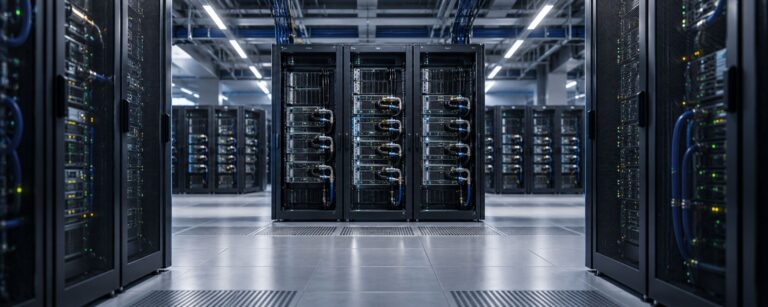
This broader perspective points toward one such answer: a closed-loop, two-phase cooling architecture that uses the evaporation and condensation of a dielectric working fluid to remove heat from electronic components. In the evaporator, or cold plate, part of the fluid changes phase as it absorbs heat from the component. The resulting vapour-liquid mixture then flows to a condenser, where the fluid returns to the liquid state and releases the absorbed thermal energy. Depending on the facility’s design, the condenser may transfer that heat to a secondary water-based circuit connected to the building’s hydraulic system. By exploiting the latent heat of vaporisation, this approach is designed to manage high thermal power densities at low mass flow rates, with lower pumping power requirements than single-phase liquid cooling systems. The connection with water scarcity should not be overstated. A rack-level cooling technology cannot eliminate the wider water footprint of an AI data centre: electricity generation, facility design and the method used to reject heat remain part of the overall equation.
What the cooling architecture can determine is where and how water is required within the thermal chain. This is the approach In Quattro has developed under its EVA Cooling® brand, through its two-phase direct-to-chip cooling technology, using a patented dielectric working fluid rather than water at the component interface. In a closed loop, no water is consumed for cooling (WUE 0), although the wider water footprint of the electricity supply remains. That distinction becomes increasingly relevant when the availability of water itself cannot simply be taken for granted. AI is therefore changing the question data centre operators need to answer. It is no longer simply how to dissipate more heat, or even how to do so using less energy. The longer-term challenge is to support increasing computing power while understanding the combination of energy, fluids, infrastructure and natural resources on which that capacity depends.
There is unlikely to be one cooling architecture that is universally sustainable. Local climate, power generation, facility design, thermal density and heat rejection all influence the outcome. But as AI infrastructure continues to scale, dependence on constrained resources becomes an increasingly important part of the design decision. This is where two-phase cooling becomes part of a wider infrastructure discussion. Supporting greater computing power per rack requires thermal systems capable of keeping pace with new generations of hardware while limiting the resources required to move heat away from increasingly dense electronics.
And as water scarcity becomes part of that operating environment, another distinction becomes increasingly important: not simply whether a cooling system is closed loop, but what role water actually plays within it.
Editorial sources:
- United Nations University Institute for Water, Environment and Health, Environmental Cost of AI’s Energy Use: Carbon, Water and Land Footprints, 3 June 2026. UNU-INWEH report and overview.
- First Street, Climate Risk in Global Data Center Markets: Implications for Investment and Performance, 18 June 2026. First Street research report.
- Sunbird DCIM, Europe’s Heatwave Is a Real-Time Stress Test for Data Center Infrastructure, 24 June 2026. Sunbird DCIM article.
- ProactivePR, Addressing the data centre ‘heatwave’ with new cooling solutions, June 2026. ProactivePR article.
- In Quattro, Two-phase flow cooling technology. In Quattro technology overview.