

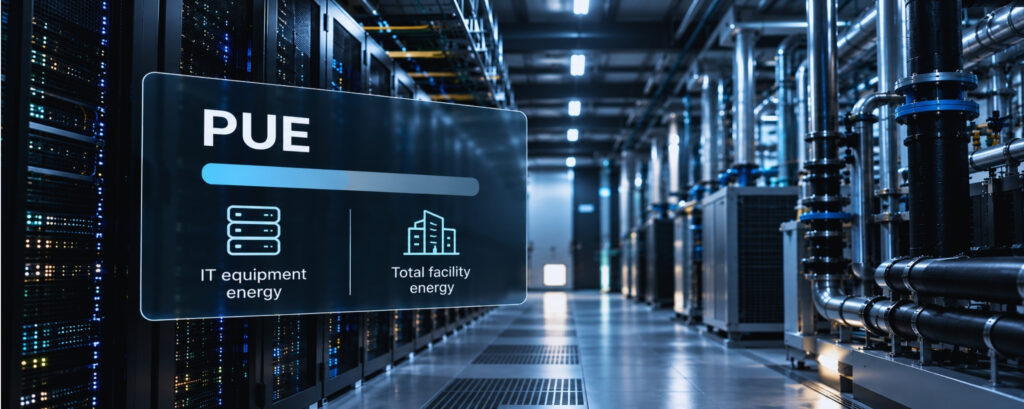

The increase in computing power required by AI workloads is making cooling an increasingly important part of data centre energy efficiency. The more computing capacity is concentrated within racks, the more heat needs to be removed and the more energy is required to support that process.
One of the indicators used to measure this efficiency is PUE, Power Usage Effectiveness, defined by Uptime Institute as the ratio between the total energy used by a data centre and the energy consumed directly by its IT equipment. The closer the value is to 1, the less additional energy the infrastructure requires to support the IT load. Uptime Institute reports an average annual PUE of 1.52 in 2026, as outlined in The growing PUE advantage of larger data centers. But what does a difference in PUE actually mean in terms of energy?
PUE
Power Usage Effectiveness: the ratio of total data centre energy consumption to IT equipment energy consumption.
When PUE becomes energy
Consider, for illustrative purposes, a facility with an IT load of 1 MW and a PUE of 1.6. The data centre therefore draws approximately 1.6 MW in total: 1 MW for IT equipment and around 600 kW in facility overhead. That overhead is not all cooling. It also includes power distribution, losses and other supporting systems. PUE therefore measures overall facility efficiency rather than cooling consumption alone. Now consider the same IT load in a second illustrative scenario, in which the facility adopts a two-phase pumped-flow cooling solution and has an overall PUE of 1.15. The IT load remains at 1 MW, while facility overhead falls to approximately 150 kW.
The difference between the two scenarios is therefore 450 kW. This cannot be attributed entirely to cooling, but represents the difference in overall facility overhead between two infrastructures supporting the same IT load at different levels of efficiency. If the IT load remains constant at 1 MW throughout the year and the two PUE values are representative of the same operating period, that difference is equivalent to approximately 3.94 GWh of energy per year.
Seen this way, PUE becomes more than an abstract efficiency ratio. It provides a way to understand how differences in facility performance can translate into meaningful changes in the amount of energy required to support the same computing load. This does not isolate cooling consumption, but it makes the scale of infrastructure efficiency easier to understand. This is an illustrative comparison, not a guaranteed performance level for every data centre adopting two-phase cooling. Final PUE depends on the facility as a whole, its design and operating conditions.
From energy to operating cost
The same difference can also be translated into cost. Assuming, for illustrative purposes, an electricity tariff of € 0.15/kWh, the 3.94 GWh difference between the two scenarios would correspond to approximately €591,000 per year. This is not intended to represent an average European electricity price, nor a cooling-specific saving. It is the financial value of the difference in total facility energy use between the two scenarios. By replacing € 0.15/kWh with their own tariff, operators can estimate the corresponding impact for their own facility.
This is also one of the starting points for assessing liquid cooling ROI. Energy cost is only one part of the calculation: CapEx, installation, maintenance, integration with existing infrastructure and life-cycle costs must also be considered.
Why cooling is becoming increasingly important
How much of a data centre’s energy is actually used for cooling? PUE alone cannot answer this, because it measures the efficiency of the facility as a whole. In its Energy and AI report, the International Energy Agency estimates that cooling and environmental control account for around 7% of total electricity consumption in the most efficient hyperscale data centres, while the figure can exceed 30% in less efficient enterprise data centres.
The difference reflects factors such as climate, facility design, heat-rejection systems and IT load. Air cooling therefore remains important, but as more heat is concentrated into smaller spaces, relying on air alone becomes progressively more difficult. Uptime Institute notes in Liquid cooling will not outgrow its high-density niche that direct liquid cooling is currently concentrated mainly in high-density applications where air cooling is no longer a practical alternative. For AI infrastructure cooling, therefore, the question is increasingly how to capture and transfer growing quantities of heat while reducing, where possible, the energy required to manage them.
Changing the way heat is transferred
With direct-to-chip cooling, heat is captured close to the components that generate it, through cold plates applied to CPUs, GPUs and other high-power devices. In two-phase direct-to-chip cooling, phase change also becomes part of the heat-transfer process. As In Quattro explains on its Two-phase flow cooling technology page, the system uses a mechanically pumped two-phase loop. The fluid reaches the cold plate, absorbs heat from the electronic component and partially evaporates. The liquid-vapour mixture then flows to a condenser, where the heat is rejected and the fluid returns to its liquid state.
This changes the way heat is transported away from the component. Rather than relying only on sensible heat, the process also exploits the latent heat associated with phase change, allowing more thermal energy to be transferred without requiring proportionally higher fluid flow. For high-density computing, that distinction becomes increasingly relevant as thermal loads rise.
By using the latent heat of vaporisation, the system can operate with lower mass flow rates, which can also reduce the pumping power required. The key point is not that one technology is universally better than another, but that changing the way heat is collected and transferred can affect the energy required to manage it and the overall efficiency of the facility.
Rethinking cooling without starting from scratch
Does preparing for higher compute densities necessarily mean rebuilding the infrastructure from the ground up? Not necessarily.
According to the findings of the Cooling Systems Survey 2025, analysed by Uptime Institute in DLC adoption remains slow and steady, the ability to integrate direct liquid cooling into existing infrastructure is already one
This does not mean that every data centre can be converted without modification. Each facility has its own electrical, thermal and IT constraints. But liquid cooling retrofit is not simply about replacing one cooling technology with another: it is about understanding how a new thermal architecture can work with the infrastructure already in place. The question therefore becomes not only how much it would cost to build new infrastructure for the next generation of hardware, but also how much of the existing infrastructure can be retained by changing the way heat is managed.
PUE remains an important indicator, but it does not tell us how much of a facility’s energy is used specifically for cooling. To understand the contribution of cooling, its consumption must be measured at facility level.
This is why thermal architecture matters: not only for removing heat from increasingly dense computing environments, but also for understanding how much energy is required to do so. Cooling is no longer only a thermal issue. It is part of the energy and economic equation of AI infrastructure.
Editorial sources:
- Uptime Institute, Glossary of digital infrastructure sustainability.
- Uptime Institute, The growing PUE advantage of larger data centers, 6 August 2026.
- Uptime Institute, Liquid cooling will not outgrow its high-density niche, 21 January 2026.
- Uptime Institute, DLC adoption remains slow and steady, 30 July 2025.
- International Energy Agency, Energy and AI, 2025.
- In Quattro, Two-phase flow cooling technology.