


On 4 November, we took the stage at Data Centre World Madrid alongside Techbuyer to share the first results of a testing programme on two-phase direct-to-chip cooling for AI workloads. Massimo Fatato and Giuseppe Zummo represented In Quattro, joined by Alastair Winner, Head of Innovation and Services at Techbuyer. In Quattro developed the cooling technology, Techbuyer co-ran the programme, and the experiments were carried out independently by the Centre for Responsible AI at the University of Hull.
We wanted to share the experimental approach and the data available so far, including the comparisons that still need to be repeated. Here is what we tested, what we found and what we are still checking..
24 %
of surveyed operators report having some racks at 30 kW or above, according to the Uptime Institute’s Global Data Center Survey 2026,.
Why we are asking new questions about cooling
AI and high-performance computing are increasing the thermal demands placed on data centres. According to the Uptime Institute’s Global Data Center Survey 2026, 24% of operators report having some racks at 30 kW or above, compared with 19% in 2025. Yet the industry-average Power Usage Effectiveness (PUE) remains around 1.52.
Energy is not the only concern. Water use is increasingly part of the discussion, including in Spain, where proposals to regulate data centre energy and water efficiency have evolved during 2026. Conventional cooling approaches can involve a trade-off. Evaporative heat rejection may improve energy efficiency but consumes water. Dry heat rejection reduces water demand, yet its effectiveness and energy requirements depend on operating conditions, particularly outdoor temperatures. This led us to a question: can two-phase direct-to-chip cooling help reduce this trade-off, and what can we actually measure at chip level?
How our two-phase cooling works
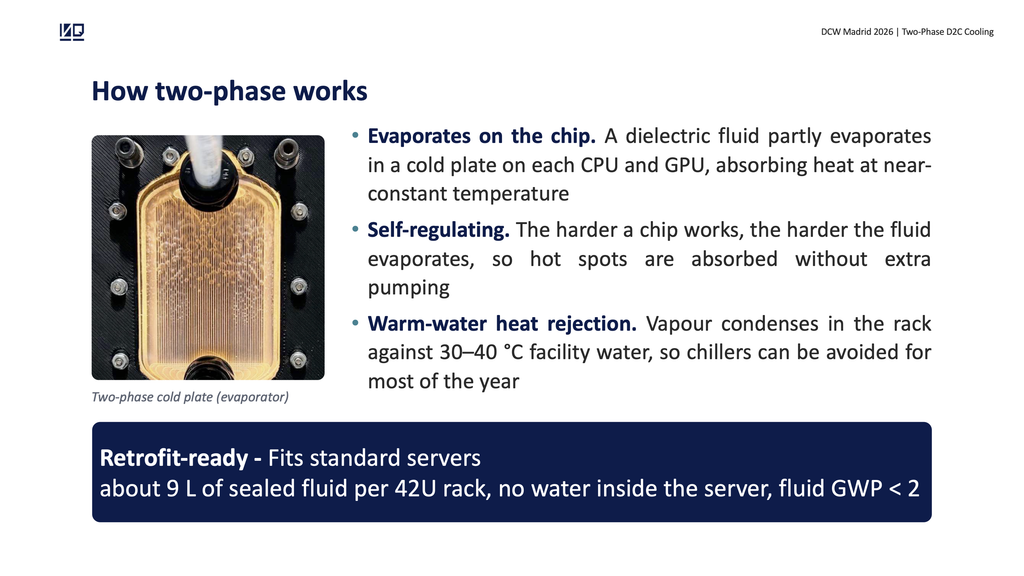
In our system, a dielectric fluid circulates through cold plates fitted directly to the CPUs and GPUs. As the chips generate heat, part of the fluid boils, absorbing thermal energy at a nearly constant temperature. Boiling responds to the local heat load. The vapour then condenses, transferring heat to a separate facility-water circuit. This architecture can operate with warmer facility water, creating opportunities to reduce reliance on mechanical chilling, depending on the data centre’s conditions and heat-rejection design.
The server-side cooling circuit uses dielectric fluid rather than water. In Quattro has separately verified operation with facility water at temperatures up to 40°C in its own laboratory. That finding is not part of the University of Hull’s experimental results.
How the tests were carried out
The study compared two HPE ProLiant DL380 Gen10 servers with identical core hardware configurations: each had two Intel Xeon Gold 6248 CPUs and two NVIDIA A40 GPUs. The key difference was the cooling system. One server retained its original air-cooled configuration, with conventional heat sinks and all six fans. The other was retrofitted with In Quattro EVA Cooling® two-phase cold plates on both CPUs and both GPUs, operating with two of its six fans.
Researchers tested two large language model fine-tuning workloads, Mistral-7B and Mistral-Nemo 12B, plus three video-language training workloads: X-CLIP, Vita-CLIP and EVL-B/16. Each workload was run twice in two-hour test windows, recording GPU temperature and power, utilisation, CPU and GPU clock speeds, and training steps.
The systems were not identical in every operating detail. The University of Hull documented differences including GPU VBIOS versions, lower CPU clock speeds on the air-cooled server and an additional load present only on the two-phase server. A software-version mismatch also affected the LLM comparisons. These factors matter when interpreting the findings.
What the measurements show
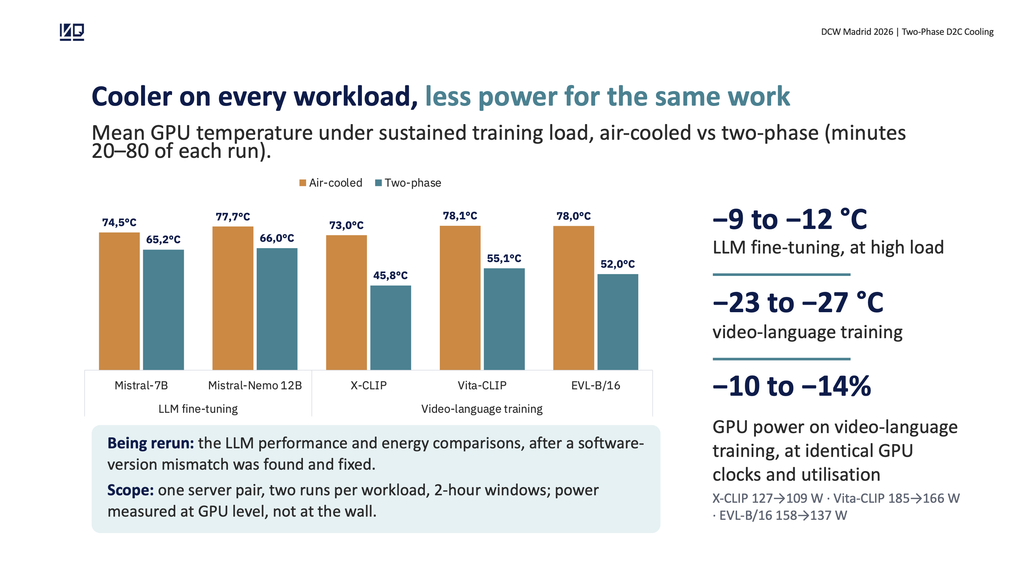
GPUs ran cooler on every workload. During high-load LLM fine-tuning, the GPUs were 9–12°C cooler. During video-language training, they were 23–27°C cooler. These comparisons use mean GPU temperatures measured between minutes 20 and 80 of each run. For the three video-language workloads, the researchers also compared GPU power at identical GPU clock speeds and utilisation. The results were:
- X-CLIP: 127 W with air cooling, 109 W with two-phase cooling.
- Vita-CLIP: 185 W with air cooling, 166 W with two-phase cooling.
- EVL-B/16: 158 W with air cooling, 137 W with two-phase cooling.
This represents 10–14% less power drawn by the GPUs during these particular workloads.
As Giuseppe Zummo, CTO of In Quattro, summarised the findings: “On video-language training, at identical GPU clocks and utilisation, the two-phase-cooled GPUs drew 10 to 14 percent less power. This is the cleanest comparison in the data.” It is worth being precise about scope: The figures describe GPU-level power, not the total power consumption of the server, the cooling system or the data centre.
Why Techbuyer is part of the programme
For Techbuyer, which specialises in circular IT, the question extends beyond cooling performance. It is also about whether existing hardware can remain useful for longer. The test systems used a server model that Techbuyer describes as a backbone of today’s refurbished market, rather than newly released hardware. A liquid cooling retrofit offers a possible route to adapting such equipment for demanding workloads without replacing an entire server fleet or rebuilding the facility. The approach is designed to be deployed rack by rack.
There is also a practical question of support. Retrofitting changes a server’s factory configuration, and Techbuyer’s experience in maintaining reconfigured and out-of-warranty equipment is relevant to keeping those systems in service. Lower, more stable operating temperatures may eventually contribute to longer hardware life and defer the embodied carbon associated with manufacturing replacements. But that benefit has not yet been demonstrated by these tests. As Alastair Winner of Techbuyer cautioned: “I want to be careful here: that’s an expectation, not yet a finding. Nobody has multi-year field data on two-phase-cooled hardware, and we’d rather measure the reliability effect than assume it.”
What we still need to establish
We see these findings as an initial data set, not a final verdict. The study involved one pair of servers and two runs per workload, with power measured at GPU level rather than at the wall. It does not establish an improvement in training speed or demonstrate that thermal throttling was prevented. Differences in operating conditions mean those conclusions cannot be drawn from the current results.
The LLM performance and energy comparisons are being rerun following the identification and correction of the software-version mismatch. Longer-term reliability will also require further testing and field evidence. We welcome scrutiny of the methodology and opportunities for independent replication.
What comes next
Our next steps are to complete the LLM reruns and bring the findings together in a white paper, including the methodology, measured outcomes and limitations. Sharing the initial results at DCW Madrid was the beginning of that wider technical discussion. We hope it will help data centre operators, hardware specialists and researchers evaluate what two-phase direct-to-chip cooling could offer for existing and future AI infrastructure.
Reserve your copy of the white paper
Sources and references
- Two-Phase Direct-to-Chip Cooling. Data Centre World Madrid 2026, presentation and speaker notes provided by In Quattro. Experimental results attributed to the Centre for Responsible AI, University of Hull.
- Uptime Institute, Global Data Center Survey Results 2026.
- Uptime Institute, The growing PUE advantage of larger data centers, 6 August 2026.
- Ashurst Perkins Coie, Data Centres: What Has Changed in the Draft Royal Decree?, 3 November 2026.